


Your Brain Needs Sunshine: The Powerful Connection Between Sun, Mood & Mental Health

From GrassrootsHealth
From serotonin and endorphins to circadian rhythm regulation and emotional resilience, sunlight plays a far greater role in mental wellbeing than many people realize
Key Points
- While getting enough vitamin D key to maintaining mental health, exposure to sunlight also promotes the production of beta-endorphins, nitric oxide, melatonin, serotonin, and dopamine – all of which play important roles in mood
- A large study of more than 86,000 adults found that brighter daytime light exposure and darker nights were consistently associated with better mood, improved wellbeing, and lower risk of depression, anxiety, PTSD, psychosis, and self-harm
- One study found that participants receiving higher amounts of sun exposure had higher average mental state scores of cognitive function compared to participants in the medium or low exposure groups; this study concluded that long-term high sun exposure throughout life could reduce the risk of cognitive impairment in the later years of life
- Maintaining optimal vitamin D levels has been associated with a lower risk of depression, anxiety, sleep disorders, suicide risk, and cognitive disorders including dementia and Alzheimer’s Disease
Are You Getting Enough Vitamin D? Check Now
Save ~25% with the Sunshine Month Bundle!
 Research continues to show positive associations between increased lifetime sunshine exposure, higher vitamin D levels, and improved cognitive health and mental-emotional wellbeing. While getting enough vitamin D itself is key to maintaining mental health, research continues to show us that there are several other ways through which exposure to sunlight and following natural light and dark cycles can boost our mood and benefit our mind.
Sunshine Initiates the Release of “Feel-Good” Chemicals and Important Biological Processes
While exposure to UVB from sunlight produces vitamin D, aka the “Sunshine Vitamin,” it also results in the release of several other mood-enhancing chemicals and initiates multiple biological processes in the body to support a healthy brain and mood.
Beta-endorphins are naturally occurring opioids produced upon sun exposure that promote mood enhancement, relaxation, and pain relief. Interestingly, studies such as that by Kemeny et al. have demonstrated how avoidance of sunshine and vitamin D deficiency could be a contributing factor to decreased pain relief and even increase the risk of opioid addiction.
Nitric oxide, which is produced upon exposure to UVA and UVB from sunlight, has been shown to reduce inflammation and oxidative stress, resulting in decreased anxiety and depression.
The release of melatonin and serotonin are also prompted by sun exposure, both of which are associated with sleep regulation, improved mood, and easing anxiety. A study by Kent et al. discussed how a lack of sunlight can result in altered serotonin levels, neurodegeneration, depression, and other cognitive deficits. The study showed how sunlight and light therapy can help with the regulation of both the melatonin and serotonin systems among patients with seasonal affective disorder (SAD), bipolar disorder, and schizophrenia, which may also be one of the mechanisms by which sunlight can affect Alzheimer’s disease, Parkinson’s disease, and sleep disorders.
Dopamine is another chemical in the body that is released upon exposure to sunshine. Dopamine, AKA the “feel-good neurotransmitter,” is known to boost mood and motivation, and is also linked to reduced depression and anxiety. A study evaluating the correlation between dopamine and sunshine by Tsai et al. found that dopamine receptor availability was significantly greater among participants with the highest amount of sunshine exposure compared to the lowest, indicating a sensitivity of the dopamine system to variations in the amount of sun exposure a person gets.
Light exposure also influences mood indirectly through circadian rhythm regulation and also through direct neurological pathways. The eyes contain specialized light-sensitive retinal cells containing melanopsin to communicate directly with brain regions involved in mood and emotional regulation, including the amygdala and lateral habenula. Research such as that by Burns et al. suggests that modern indoor lifestyles may deprive many individuals of the bright daytime light needed for optimal circadian and neurological signaling while simultaneously exposing individuals to excessive artificial light at night. This mismatch may contribute to disrupted sleep, lower mood, and poorer mental wellbeing.
Sunshine Exposure and Risk of Depression and Suicide
A 2025 study by Tanaka and Matsubayashi examined the relationship between sunlight exposure and suicide rates using U.S. county-level data collected between 1979 and 2004. Rather than simply looking at seasons or geographic regions, the researchers analyzed month-to-month changes in solar insolation, a detailed measure of the amount of sunlight energy reaching the Earth’s surface after accounting for factors such as cloud cover, weather, atmospheric conditions, and day length. After adjusting for temperature, precipitation, geographic differences, and seasonal patterns, the researchers found that lower sunlight exposure was consistently associated with higher suicide rates. Specifically, a one standard deviation decrease in sunlight over the current and previous month was associated with a 6.76% increase in suicide rates. The strongest effects were seen across a two-month period, suggesting that reduced sunlight may gradually worsen mental well-being over time rather than acting only as an immediate trigger.

The figure above demonstrates a clear dose-response relationship: as sunlight exposure increases, suicide risk progressively decreases. The figure also shows that this relationship remained remarkably consistent across multiple statistical models and sensitivity analyses, reinforcing the robustness of the association between insufficient sunlight exposure and suicide risk.
The authors suggest that sunlight may influence suicide risk through biological effects on mental health, including disruptions in circadian rhythms, serotonin signaling, melatonin regulation, sleep, and vitamin D production. Supporting this idea, the study also found that lower sunlight exposure was associated with increased Google searches containing depressive language, suggesting broader effects on population mental health beyond suicide alone.
This study provides strong empirical evidence that diminished sunlight exposure significantly increases suicide risk, reinforcing the idea that environmental light is a key determinant of mental health. The results suggest public health interventions could consider environmental and seasonal factors in suicide prevention strategies.
The Relationship Between Light, Circadian Rhythm & Mood
A 2023 study by Burns et al. examined objective light exposure patterns in 86,772 adults and found that people exposed to brighter light during the day and lower light at night had significantly better mental health outcomes. In contrast, individuals with higher exposure to light at night had increased risk of major depressive disorder, anxiety, PTSD, psychosis, bipolar disorder, and self-harm behaviors. Those in the brightest nighttime light exposure group had approximately 30% higher risk of depression and self-harm, while those with the brightest daytime light exposure had roughly 20% lower risk of depression and self-harm compared to those with the lowest daytime light exposure.

The authors suggest these findings are closely tied to the body’s circadian rhythm system, which is strongly regulated by natural light-dark cycles. Bright daytime light helps strengthen and synchronize circadian rhythms, improve alertness, and support healthy mood regulation, while light exposure at night can suppress normal circadian signaling and disrupt sleep and hormonal rhythms. They note that modern lifestyles often expose people to the opposite pattern our biology evolved under; dim indoor lighting during the day combined with excessive artificial light at night from screens, indoor lighting, and urban environments. They propose that increasing daytime outdoor light exposure while minimizing nighttime light exposure may represent a simple, accessible, non-pharmacological strategy to support mood, alertness, emotional resilience, mental wellbeing, and overall brain health.
Additional Ways Sunshine and UVB Exposure Have been Shown to Affect Mental Health
Lower Risk of Generalized Anxiety Disorder
Limited or minimized sunshine exposure has also been associated with and increased risk of generalized anxiety disorder (GAD). A 2022 study by Al Anouti et al. found such an association among female college students who practiced more sun avoidance habits that minimized their exposure to sunshine; in fact, the score used to assess sun exposure habits was a strong predictor of GAD status. The risk of GAD was also increased among women with a low dietary intake of vitamin D, and those with a history of vitamin D deficiency.
“The findings showed clear evidence that sun avoidance behaviors are strongly associated with an elevated risk of generalized anxiety disorder…”
Better Mood and Improved Sense of Wellbeing
Studies have correlated increased levels of interleukin-6 (IL-6) with major depressive disorder, and cortisol with immune and mood imbalances. A study by Toledo et al. found an improvement in mood and wellbeing with narrow-band UVB exposure. The study looked at whole-body exposure to narrow-band UVB and its impact on mood, as well as resulting levels of vitamin D, interleukin-6 (IL-6), cortisol, and beta-endorphins (B-END). Mood was scored based on satisfaction, tiredness, wellbeing and irritation, with higher scores representing worse moods. Participants experienced significant improvements in mood over the five days following NB UVB exposure. Both vitamin D and cortisol levels were correlated with the baseline mood state, and from beginning to end of the study, vitamin D levels increased while IL-6 levels decreased.
Improved Infant Motor Development and Postpartum Depression
A study by Zhang et al. found that infants receiving vitamin D (400 IU/day) plus sunlight had better motor development scores and lower cortisol levels over the next two months compared to infants only taking vitamin D supplements (400 or 1000 IU/day) or the control group. Infants in the highest sun exposure group (7-14 hours/week) achieved the best scores and had the lowest cortisol levels.
Further, mothers who received sunlight exposure had improved depression scores and lower cortisol levels compared to mothers who did not receive sunlight exposure. These findings indicate that sunlight and vitamin D supplements combined can improve motor development, lower cortisol levels, and improve depressive symptoms.
Seasonal Affective Disorder
One in ten Americans suffer from a recurring depression called Seasonal Affective Disorder (SAD) for which their symptoms often start in late fall or early winter when the days are short, and go away in the spring when the days lengthen. In other words, they feel better when there is more UVB available with sunlight. The risk is much higher for people who live further from the equator, where the length of the days varies more greatly throughout the year. Light therapy, exposure to artificial UVB lamps, has been shown to be an effective treatment for people with SAD, improving symptoms by 50-80%.
Reduced Risk of Cognitive Impairment
A study by Gao et al. looked at data from 1192 participants aged 60 years and older and residing in rural China who provided information about their long-term sun exposure behaviors including time of day when outdoors, duration outdoors, and use of sun protection. The research team used the Mini-Mental State Examination (MMSE; maximum score of 30) to assess participant’s orientation, memory, language, calculation, and attention. They found that participants in the high sun exposure group had higher average mental state scores of cognitive function compared to participants in the medium or low exposure groups. This study concluded that long-term high sun exposure throughout life could reduce the risk of cognitive impairment in the later years of life.
The Sunshine Vitamin Itself is Essential to Emotional Well-being
Vitamin D alone plays an essential role in the health of the brain and nervous system and in the development of depression, and has been shown to have beneficial effects on depression, stress, anxiety, and sleep.
One study by Ataie-Jafari et al. looking at the association between vitamin D levels and mental health among 1095 children and adolescents found “significant associations between vitamin D deficiency and self-reported psychiatric distress as angriness, anxiety, poor quality sleep, sadness/depression, and worry.” Another study by Bahrami et al. found that vitamin D supplementation had significant reductions in all levels (mild, moderate, and severe) of depression among teenage girls.
A study among adult Canadians assessed the relationship between vitamin D levels and different indicators of mental health such as depression, anxiety, and stress. This study found that all measured indicators of mental health (emotional health, self-perceived mental health, self-perceived general health, and self-perceived stress) were positively associated with higher vitamin D levels.
A 2023 study by Lavigne et al. examined the risk of suicide attempts and intentional self-harm among US Veterans who had either received vitamin D treatment or who had not received vitamin D treatment in the previous years. The study found that vitamin D supplementation was associated with a 45-48% lower risk of suicide attempt and self-harm; the higher the dose of vitamin D, the greater the risk reduction, with a greater risk reduction found among Black veterans compared to White veterans.
Vitamin D Levels Associated with Dementia and Other Cognitive Health Disorders
Higher levels of vitamin D within the brain have been associated with lower risk of dementia and Alzheimer’s Disease, as well as better global cognitive function scores, a slower rate of cognitive decline, and better semantic and working memory.
A new 2026 study by Mulligan et al. found that vitamin D levels at mid-life (in the 30s and 40s) were directly related to signs of dementia later in life. This prospective study followed 793 dementia-free adults with an average age of 39 years and compared baseline serum 25(OH)D levels with amyloid- and tau-PET brain scans performed approximately 16 years later. The study found that individuals with higher vitamin D levels in midlife had significantly lower tau accumulation in the brain years later, particularly in regions vulnerable to early Alzheimer’s disease pathology.
One particularly important finding was the difference between analyzing vitamin D as a continuous variable versus simply comparing people above or below 30 ng/mL. When vitamin D levels were evaluated continuously, higher levels were consistently associated with lower global and composite tau burden, suggesting a dose-response relationship in which increasing vitamin D status may provide progressively greater protection. However, when researchers divided participants into groups above or below 30 ng/mL, the associations were weaker and no longer statistically significant in the fully adjusted models. The authors suggest this may reflect the relatively small number of participants with low vitamin D levels, but exploratory analyses hinted that the greatest protection may occur at higher levels, particularly in the 55–99 ng/mL range.
Overall, the study supports the idea that maintaining higher vitamin D status during midlife may help reduce later tau-related neurodegenerative changes associated with Alzheimer’s disease, and that vitamin D insufficiency could represent a modifiable risk factor long before symptoms appear.
Another study by Ghahremani et al. looked at data from 12,388 participants who were dementia free at the beginning of the study to determine the effect of prescribed vitamin D supplementation on the risk of developing dementia over the ten-year study period. They found a 40% decreased risk of developing dementia among those taking vitamin D supplements.
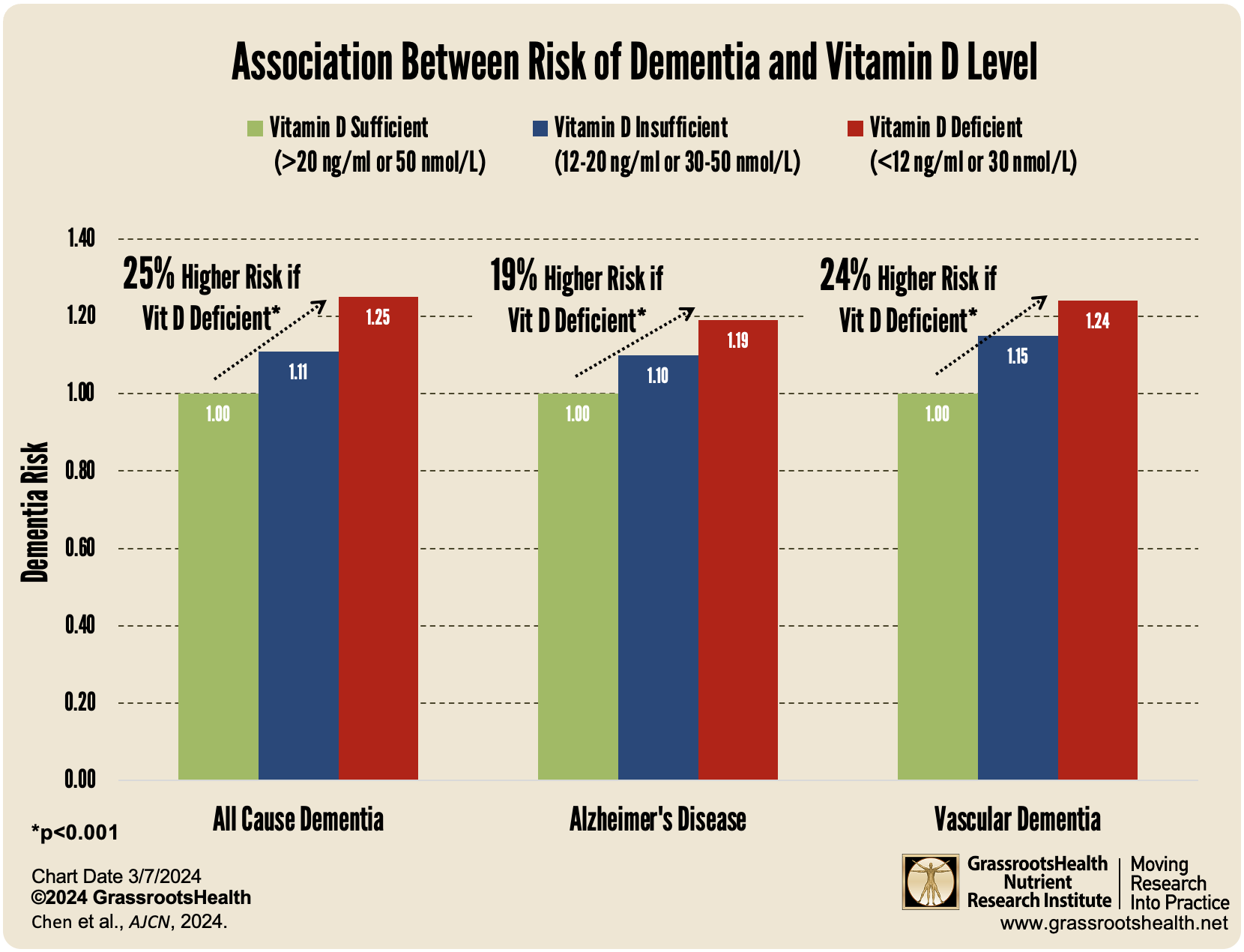
A study published in 2024 by Chen et al. looked at data from 269,229 adults (ages 55 to 69 years old) to determine the relationship between vitamin D supplementation and vitamin D levels on the incidence of dementia over a 14-year period. Over half (52.3%) of the participants had vitamin D levels below 20 ng/ml (50 nmol/L), with 18.3% deficient (defined as below 12 ng/ml or 30 nmol/L) and 34% insufficient (between 12-20 ng/ml or 30-50 nmol/L). The chances of vitamin D deficiency and insufficiency were lower among those taking supplements, however, vitamin D deficiency still occurred among 6.9% of those taking vitamin D and 9.5% of those taking multivitamins, compared to 21.5% of those who did not supplement. The study found a 19-25% increased risk of dementia among those with vitamin D deficiency, and a 10-15% increased risk among those with vitamin D insufficiency. Findings for the increased risk among vitamin D deficient and insufficient participants were statistically significant for all three groups of dementia and remained significant when adjusting for variables.
Enroll in D*action and Test Your Levels Today! Purchase the Sunshine Month Bundle to get 2 vitamin D test kits (one for before summer, one for after summer) plus get the Sunshine eBook with your purchase.
SmartTan.com news articles regularly report medical and scientific information to keep you abreast of current events related to UV light. This information is not intended to be used by any party to make unwarranted health claims to promote sunbed usage. Indoor tanning businesses are obligated to communicate a fair and balanced message to all clients about your products and services including the potential risks associated with indoor tanning. Contact your Smart Tan representative to find out more about what you can and can’t say in your tanning salon business.
© 2026 International Smart Tan Network. All rights reserved.


