


How Much Sun Is Right for You? It Starts With Your Skin Type

From GrassrootsHealth
Maximize benefits and reduce harms of sun exposure by understanding your skin type and following evidence-based recommendations for an individualized approach to sun exposure and protection
Key Points
- In March 2023, Australia became the first country to provide updated guidelines for sun exposure based on skin type, risk of skin cancer, and risk of vitamin D deficiency, officially recommending increased sun exposure for darker skinned people
- Darker skin contains more melanin, which acts as a natural sunscreen. While this decreases the likelihood of sunburns and skin cancer, the more melanin skin contains the longer it takes to produce vitamin D, so that a person with skin type VI may require more than 10 times the length of UVB exposure to make the same amount of vitamin D as someone with skin type II
- Once you know your skin type, you can get a better idea of your overall risk for skin cancer and sunburn. The next step is to determine how much time you can expose your skin to sunlight without burning; after that amount of time is when it is important to cover up, apply sunscreen, or get out of the sun.
Skin pigmentation plays a protective role against UV damage from the sun and helps to protect against sunburns and skin cancer. At the same time, higher amounts of skin pigmentation slows vitamin D production in the skin, leading to an increased risk of vitamin D deficiency. Since this can result in differing, whole-body health consequences based on the darkness of an individual’s skin color, the need for a more individualized approach that considers skin type when making recommendations for sun exposure has become clear.
Watch a Short Video to Learn More About this Topic
How to Determine Your Skin Type & Sun Exposure Considerations
Knowing your skin type is essential for personalizing your sun exposure.
Darker skin contains more melanin, which acts as a natural sunscreen. While this decreases the likelihood of burns and skin cancer, the more melanin skin contains the longer it takes to produce vitamin D. For example, a person with skin type VI may require more than 10 times the length of UVB exposure to make the same amount of vitamin D as someone with skin type II.
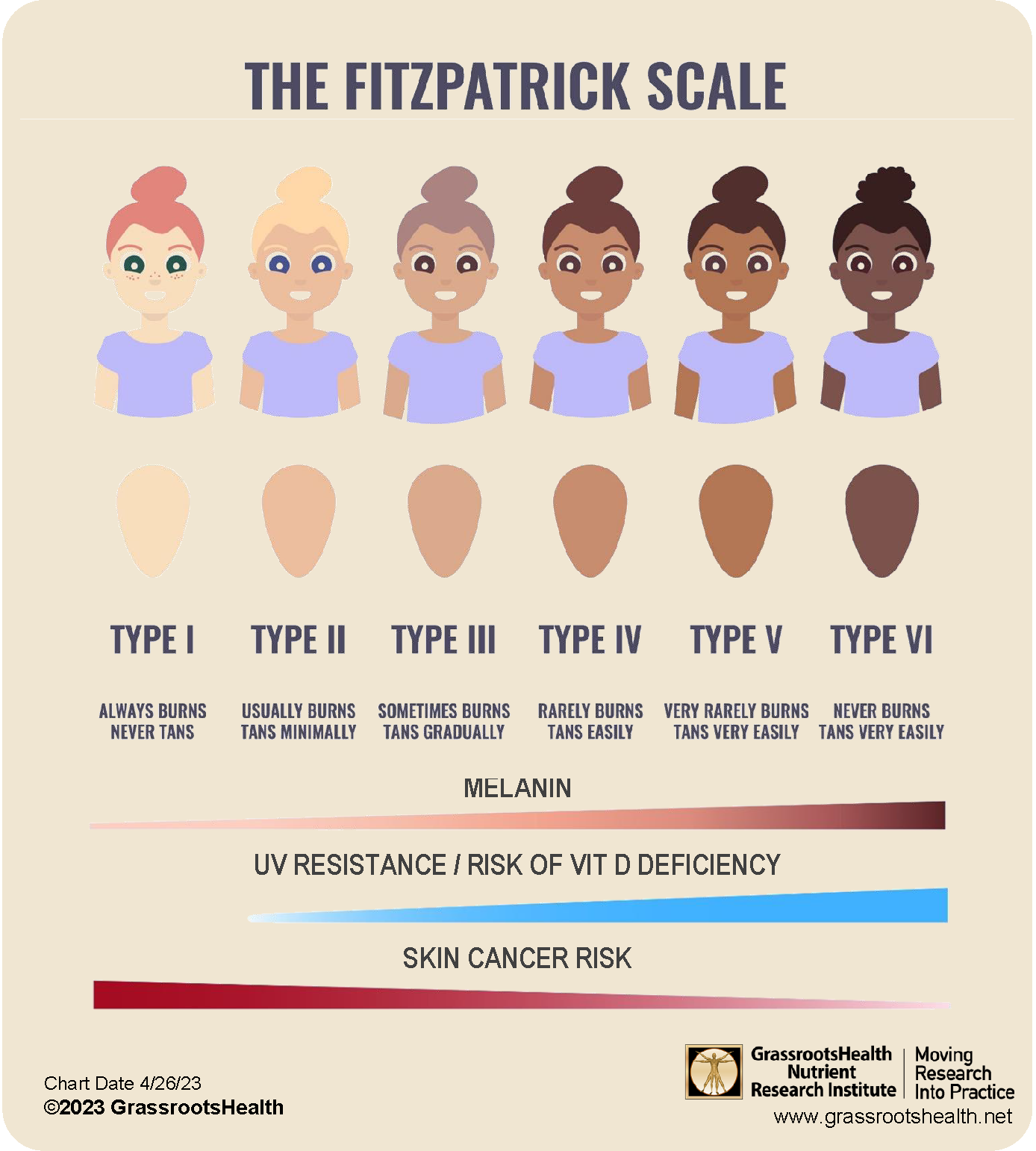
The Fitzpatrick Skin Type Scale is a widely used system that classifies skin based on how it responds to sunlight, specifically, how easily it burns and how well it tans. Originally developed by Thomas B. Fitzpatrick, this scale helps guide safe sun exposure, skin cancer risk assessment, and how efficiently your body can produce vitamin D from sunlight.
There are six skin types, ranging from very fair (Type I) to very dark (Type VI).
Type I – Very Fair
Skin tone: Very pale, often with freckles
Hair/Eyes: Red or blonde hair, light eyes
Sun response: Always burns, never tans
Vitamin D considerations: Can produce vitamin D quickly, but has the highest risk of sunburn
Guidance: Very short, careful sun exposure
Type II – Fair
Skin tone: Fair
Hair/Eyes: Light hair, light to medium eye
Sun response: Burns easily, tans minimally
Vitamin D considerations: Efficient vitamin D production, but still burn-prone
Guidance: Moderate caution; short exposures with gradual increase
Type III – Medium
Skin tone: Light to medium (often described as “olive”)
Hair/Eyes: Darker hair, varied eye color
Sun response: May burn initially, then tans gradually
Vitamin D considerations: Balanced—moderate production with moderate burn risk
Guidance: Can tolerate longer exposure, but still avoid prolonged unprotected sun
Type IV – Olive/Brown
Skin tone: Olive or light brown
Hair/Eyes: Dark hair and eyes
Sun response: Rarely burns, tans easily
Vitamin D considerations: Requires longer sun exposure to produce adequate vitamin D
Guidance: Lower burn risk, but still important to monitor duration and intensity
Type V – Brown
Skin tone: Medium to dark brown
Hair/Eyes: Dark
Sun response: Very rarely burns, tans deeply
Vitamin D considerations: Reduced vitamin D production efficiency due to higher melanin
Guidance: Needs significantly more sun exposure to reach optimal vitamin D levels
Type VI – Deeply Pigmented
Skin tone: Deeply pigmented (dark brown to black)
Hair/Eyes: Dark
Sun response: Almost never burns
Vitamin D considerations: Lowest efficiency of vitamin D production from sunlight
Guidance: Requires the longest sun exposure; higher risk of vitamin D deficiency despite sun availability
The Fitzpatrick scale is shown below with the different skin types based on their response to UV radiation. The skin type quiz can help you determine your type.
Updated, Evidence-Based Sun Exposure Recommendations by Skin Type
For decades, the general recommendation for everyone has been to avoid the sun, cover up, and apply sunscreen regularly. Certain authorities have been questioning this strategy, with some having updated their official recommendations while urging others to do the same:
- In 2010, a joint position statement was issued in the UK by groups that included Cancer Research UK, British Association of Dermatologists, Diabetes UK, the Multiple Sclerosis Society, the National Heart Forum, the National Osteoporosis Society and the Primary Care Dermatology Society; it urged people to “…enjoy the sun safely and take care not to burn, helping to ensure the benefits of vitamin D can be enjoyed without the risk of skin cancer being raised unnecessarily.”
- In 2016, a meeting sponsored by the US National Cancer Institute called for updated sun exposure guidelines based on individual risk factors, highlighting the beneficial effects of sun exposure, including vitamin D production and nitric oxide release, stating “Reducing risk for one disease should not come at the cost of increasing risk for another.”
- In February, 2022, the World Health Organization hosted a webinar, “Striking a balance: harms and benefits of sun exposure,” which discussed the benefits of sunshine exposure, most notably the production of vitamin D, with an emphasis on how the balance of benefits and harms differs by skin type.
- In March 2023, Australia became the first country to update their official sun exposure guidelines based on skin type, risk of skin cancer, and risk of vitamin D deficiency, recommending increased sun exposure for darker skinned people.
“These new recommendations on sun safety balance the positive effects of sunlight such as ultraviolet B radiation for vitamin D synthesis against the risks of skin cancer. Guidelines now reflect the ethnic diversity of the Australian population, with advice differing according to the individual risk of skin cancer based on skin pigmentation and history.” Dr. Rebecca Mason
Key Concepts Upon which these Recommendations are Based
The key points from the Australian Position Statement released in 2023 were made into a research paper and published in the Australian and New Zealand Journal of Public Health in early 2024. As it reports:
“The balance of risks and benefits of sun exposure is not the same for everybody. For people at very high risk of skin cancer, the risks of exposure likely outweigh the benefits; sun protection is essential. Conversely, people with deeply pigmented skin are at low risk of skin cancer but at high risk of vitamin D deficiency; routine sun protection is not recommended. For those at intermediate risk of skin cancer, sun protection remains a priority, but individuals may obtain sufficient sun exposure to maintain adequate vitamin D status.”
How much does skin cancer risk vary by skin type? Individuals with very dark skin (a Fitzpatrick skin type of 5 or 6 – see below) have an extremely low risk of skin cancer. For example, in the United States, compared to non-Hispanic White men and women, the incidence of melanoma is 30 times lower in Black men and 26 times lower in Black women. In fact, “melanin affords approximately 60-fold protection against DNA damage in the basal layer of Fitzpatrick type VI skin compared with type I and II skin.”
Darker skin contains more melanin, which acts as a natural sunscreen. While this decreases the likelihood of sunburns and skin cancer, the more melanin skin contains the longer it takes to produce vitamin D. For example, a person with skin type VI may require more than 10 times the length of UVB exposure to make the same amount of vitamin D as someone with skin type II.
“Sun protection strategies must reflect the understanding that human skin pigmentation evolved to balance the negative and positive effects of sun exposure…” Geller et al. (2018)
In summary:
- Darkest skin colors = lower risk for skin cancer but higher risk of vitamin D deficiency = routine sun protection not recommended
- Lightest skin colors = higher tendency to burn, higher risk of skin cancer = sun protection is essential
- Those in between must find a balance between sufficient, sensible sun exposure, and sun protection
Tips for Personalizing Your Sun Exposure Time to Make Vitamin D and Avoid Sunburn
 Once you know your skin type, you can get a better idea of your overall risk for skin cancer and sunburn. The next step is to determine how much time you can expose your skin to sunlight without burning; after that amount of time is when it is important to cover up, apply sunscreen, or get out of the sun.
Try the dminder App
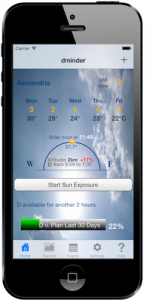
You can use tools such as the free dminder app to approximate how much time to spend in the sun without burning, and to estimate how much vitamin D you might be producing while in the sun. The dminder app is an excellent tool, as it takes into account not only latitude, season, and time of day but also weather conditions and skin type that affect vitamin D production and risk of sunburn.
Expose More Skin at a 90-degree Angle
Greater amounts of vitamin D are made when more skin is exposed, especially the back and shoulders, as these contain the most surface areas on your body. It is better to expose more skin for less time to ensure you do not overexpose yourself and burn. Ideally, skin should be exposed to the sun on a 90-degree angle.
“People with darker skin and lower risk of skin cancer and a higher risk of vitamin D deficiency are advised to spend sufficient time outdoors with ample skin exposed when the UV Index is ≥3 to obtain a vitamin D-effective dose of UV radiation without sun protection.” Dr. Rachel Neale
Cover Up to Avoid Burning
To make vitamin D, the skin must be exposed to sunlight without sunscreen or clothing (along with several other factors, explained in detail here). Sunscreen blocks the UVB rays needed to produce vitamin D, and should be applied only after the exposure time allotted for making vitamin D. Sunshine expert, Dr. Michael Holick, typically recommends covering up the sensitive parts of the skin (face, top of the hands, ears) but exposing the larger surfaces of the body (arms and legs), without sunscreen, for a reasonable amount of time and without burning to make vitamin D and the other biochemicals resulting from sunshine exposure before covering up or applying sun protection.
Allow Your Skin to Acclimate
Whether or not you choose to use an app, it is important to allow skin to gradually acclimate to the sun, especially for those who spend a lot of time indoors, have lighter skin, after winter months, or during sun-seeking vacations. It is safer to increase exposure time gradually as this allows your skin to adapt to the sun’s intensity while safely producing a tan. And, as a tan develops, it will allow for greater amounts of time in the sun with less risk of UV damage.
SmartTan.com news articles regularly report medical and scientific information to keep you abreast of current events related to UV light. This information is not intended to be used by any party to make unwarranted health claims to promote sunbed usage. Indoor tanning businesses are obligated to communicate a fair and balanced message to all clients about your products and services including the potential risks associated with indoor tanning. Contact your Smart Tan representative to find out more about what you can and can’t say in your tanning salon business.
© 2026 International Smart Tan Network. All rights reserved.


